 ultimate-guide
Is Structured Sewing Training Effective? 2026 Guide
Table of Contents
- Why Structured Sewing Training Beats Random Tutorials
- Essential Sewing Skills for Beginners to Master First
- How Long Does It Take to Learn Sewing With Structure?
- The Cost-Benefit Case for Structured Courses
- What Structured Training Gets Right That Tutorials Miss
- Building Confidence and Precision Through Projects
- Frequently Asked Questions
Last Updated: September 16, 2026
Why Structured Sewing Training Beats Random Tutorials
Structured sewing training is a curriculum-based approach that sequences lessons so each project builds on the last, rather than leaving you to piece together scattered videos. This guide from Common Sewing breaks down whether that approach works, and for whom.
It works because of the order, not the video quality or instructor's personality. Structured sewing training removes the guesswork of what to learn next, separating beginners who finish garments from those who quit halfway through a tote bag.
Random tutorials aren't useless, just incomplete: a ten-minute zipper video won't tell you to stabilize the fabric first or that your seam allowance was off three steps ago.
According to research on deliberate practice and skill acquisition, learners improve fastest when practice is sequenced, feedback is immediate, and difficulty increases gradually.
"Structured" is a spectrum, not a binary, a course can have a syllabus and still be poorly sequenced.
Essential Sewing Skills for Beginners to Master First
The essential sewing skills for beginners are a small, finite set: machine control, seam allowance accuracy, pressing, and reading a basic pattern. Master those four and everything else becomes a variation on a theme.
Most beginners skip straight to garment construction and wonder why their projects look homemade instead of handmade, the problem is rarely the fabric or machine, but the missing technical base.
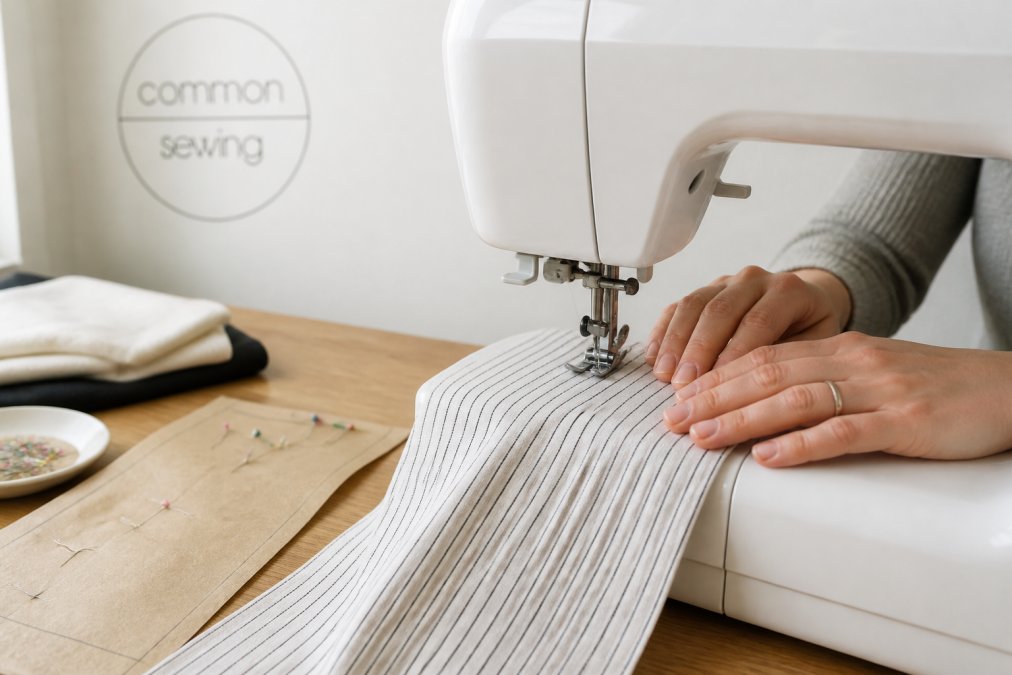
Here's the sequence that works: machine proficiency (threading, tension, stitch length), seam allowance discipline, pressing as you go, fabric manipulation, and pattern reading (grain lines, notches, markings).
A curriculum-based course makes you sew straight lines for a week before you touch a pattern. That feels slow. It isn't.
How Long Does It Take to Learn Sewing With Structure?
The difference is eliminating the "what do I learn next" decision, not learning faster.
The learning curve is front-loaded: the first twenty hours are hardest, building muscle memory and vocabulary at once. After that, progress accelerates noticeably.
Several factors shift that timeline: practice frequency (thirty minutes four times a week beats one three-hour session), project-based learning, feedback loops, and skill progression design where each project introduces exactly one new technique.
What most people underestimate is confidence: a beginner who completes a wearable garment in month two keeps going, while one who abandons a half-finished dress usually stops sewing entirely.
Sign up with your email address to receive news and updates. →
The Cost-Benefit Case for Structured Courses
Structured courses cost more upfront than free tutorials, and the return comes from completion rates rather than access to information. The question isn't whether the information is free elsewhere. It's whether you'll actually finish.
Consider what an unfinished learning path costs: fabric, patterns, and notions for abandoned projects add up quietly, as does a machine that sits unused because you never got past the confusing stage.
A hybrid model often makes the most sense: a structured core curriculum for fundamentals, supplemented by free tutorials when you need a technique explained a second way.
Approach | Upfront Cost | Completion Likelihood | Best For |
|---|---|---|---|
Free tutorials only | None | Low | Testing whether you enjoy sewing |
Structured course | Paid | Higher | Beginners who want wearable results |
Hybrid model | Paid core + free extras | Highest | Learners who need multiple explanations |
In-person classes | Highest | High | Hands-on learners near a studio |
Pricing depends on what's included, so check the provider's site for current details.
What Structured Training Gets Right That Tutorials Miss
Three things separate a real curriculum from a playlist: sequencing, feedback, and standardized skill benchmarks. A course with all three beats any collection of videos, regardless of production quality.
Skill acquisition in crafts relies on myelination, where repeated, correct practice builds neural pathways; practicing incorrectly or randomly builds the wrong ones. the Cleveland Clinic's overview of how the brain learns motor skills explains this in plain terms: repetition with correction is what consolidates a physical skill, not repetition alone.
That's why feedback loops matter more than content volume: watching a technique ten times doesn't fix your tension if you don't know it's wrong.
Standardized skill benchmarks are what self-taught sewers never encounter, without them, you can't know whether your seam is "good enough" or will fail in the wash.
Building Confidence and Precision Through Projects
Confidence comes from completed projects, and precision from repetition on those same projects, which is why project-based learning outperforms isolated technique drills.
Frequently Asked Questions
Is structured sewing training actually more effective than learning from free YouTube videos?
Structured sewing training follows a deliberate sequence that builds skills in the right order, while YouTube tutorials tend to jump between topics without a clear progression. A curriculum-based approach covers sewing fundamentals, pattern reading, and machine proficiency step by step. This reduces the frustration of tackling advanced projects before you have the technical base to complete them successfully.
How long does it take to learn sewing with a structured course?
The timeline depends on how often you practice and whether your course includes hands-on training with feedback loops.
What are the most important essential sewing skills for beginners to learn first?
Start with sewing machine proficiency, straight and curved seam construction, and basic fabric manipulation. Reading and altering patterns is equally important because it prevents costly mistakes on garment construction. A strong structured course introduces these foundational skills through project-based learning, so each completed item reinforces what you practiced before moving to the next technique.